
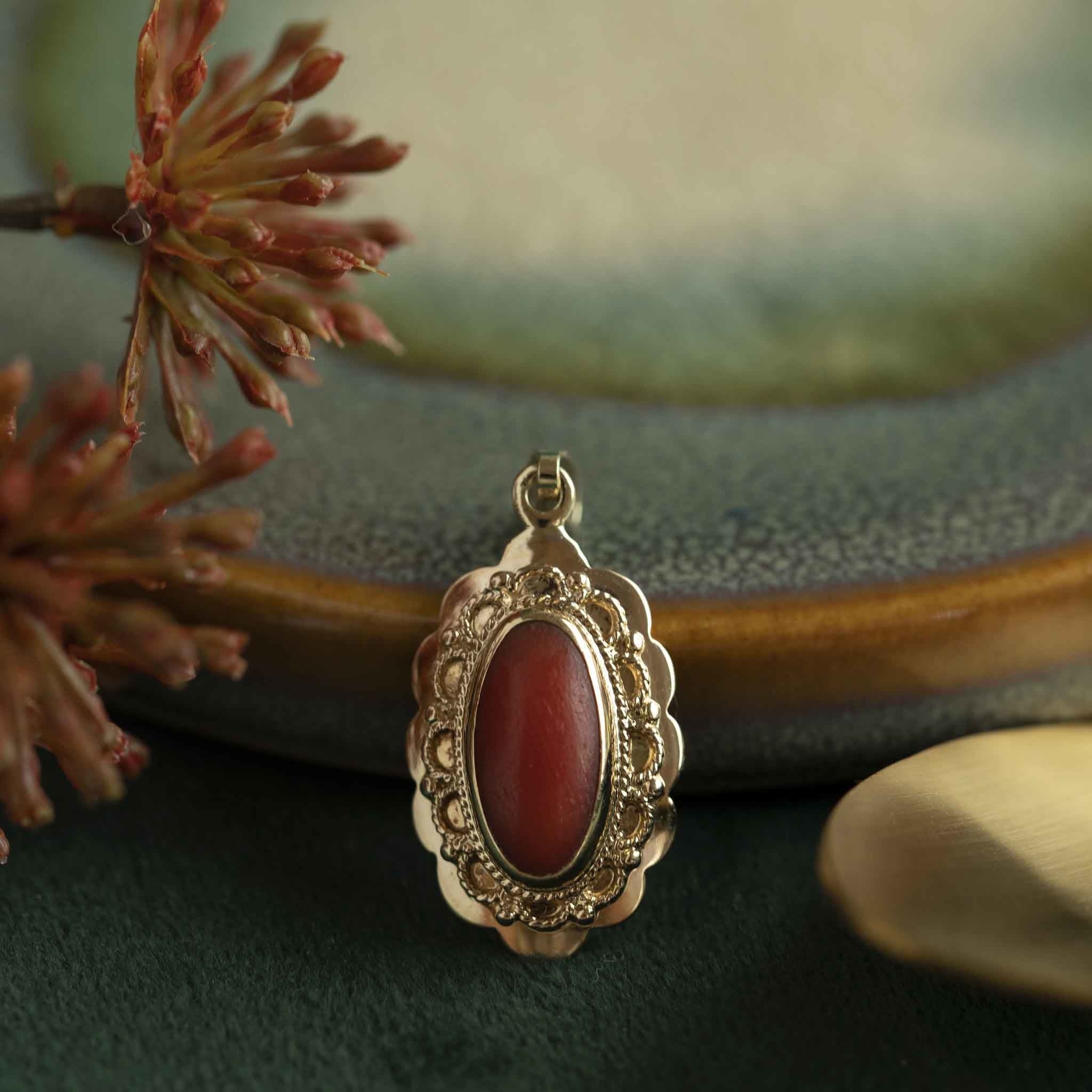
Everything you didn’t know about blood coral
Blood coral is a special material found in the sea and has been cherished for centuries for its beautiful red color. For a long time, people believed coral had protective properties and wore it as a talisman. Today, fishing for blood coral is prohibited or regulated in many places, making it rare.
Beautiful and Protective
The Greek poet Homer describes in his book Metamorphoses how coral, according to the ancient Greeks, came into existence. The hero Perseus was sent by King Polydectes to defeat Medusa—a monster with snakes for hair whose gaze turned people to stone. When Perseus—using a mirror—successfully beheaded Medusa, he placed her head in the sand. From the streams of blood flowing from her neck, coral was said to have formed.
Medusa’s head had protective powers for Perseus—he carried it on his shield and was therefore invincible—and coral was likewise seen as a material that offered protection to its wearer. This belief persisted for centuries. Young children were often given a coral amulet or teething ring. If you happen to visit the Rijksmuseum, take a look at paintings from the Dutch Golden Age: children are sometimes depicted holding rattles with coral ends. Besides helping soothe teething, people believed these coral rattles had protective qualities.
A Colorful Wonder from the Sea
Coral is a type of polyp found in the ocean. These polyps extract calcium from seawater to build their skeletons, which we recognize as coral. Coral exists in various types and colors, including white, blue, black, and gold. Light pink coral is known as “Angel Skin.” However, the most famous and valuable variety is the deep red type known as blood coral.
Until the early 20th century, blood coral was mainly found in the Mediterranean Sea. By the late 19th century, Sicily had become the center of coral production, with large quantities harvested in a short time. This success led to overfishing, threatening the reefs around the island, which prompted the Italian government to regulate coral fishing. Outside Europe, Australia and Japan are also important sources of coral.
Pure Nature
Blood coral is divided into as many as ten color shades, ranging from pale pink to deep red. The most valuable variety has a bright, deep red color and a strong, glossy finish. Sometimes—especially in coral from Japan—white streaks can appear. The finest pieces are carved into small sculptures or large beads, while lower-quality fragments are drilled and sold as branch coral.
High-quality coral requires no treatment. Lower-quality coral—now more common due to reduced availability—is often treated to achieve a more uniform color and enhanced shine.
From the second half of the 20th century onward, warming oceans reduced the production of high-quality coral. As demand remained high, treated coral entered the market. These can be easily distinguished: when treated coral comes into contact with acetone, it releases its color.
Traditional Dress
Although blood coral had been worn for centuries, in the Netherlands it became especially popular as part of regional Jewellery in the 19th and early 20th centuries. In West Friesland and Volendam, large multi-strand coral necklaces with gold clasps were worn. If you dress in traditional costume for a photo in Volendam, you’ll typically be given a large plastic imitation.
In the northern Netherlands, necklaces often consisted of two to three strands with large barrel- or cheese-shaped beads. In Zeeland, these could be five or six strands of smaller beads.
A Treaty for Coral
Pollution, human impact, overfishing, rising ocean temperatures, and sea-level rise have severely degraded coral reefs. Coral was harvested faster than it could grow, making it increasingly rare. As a result, the trade in red and pink coral is now restricted by the United Nations through the Convention on International Trade in Endangered Species of Wild Fauna and Flora (CITES). Sellers must provide documentation proving the origin of the material.
In addition to stricter regulations, modern coral is often of lower quality due to increased ocean acidity. This makes large antique and vintage coral beads especially desirable today. In this way, the original quality and value are preserved—without harming nature.