
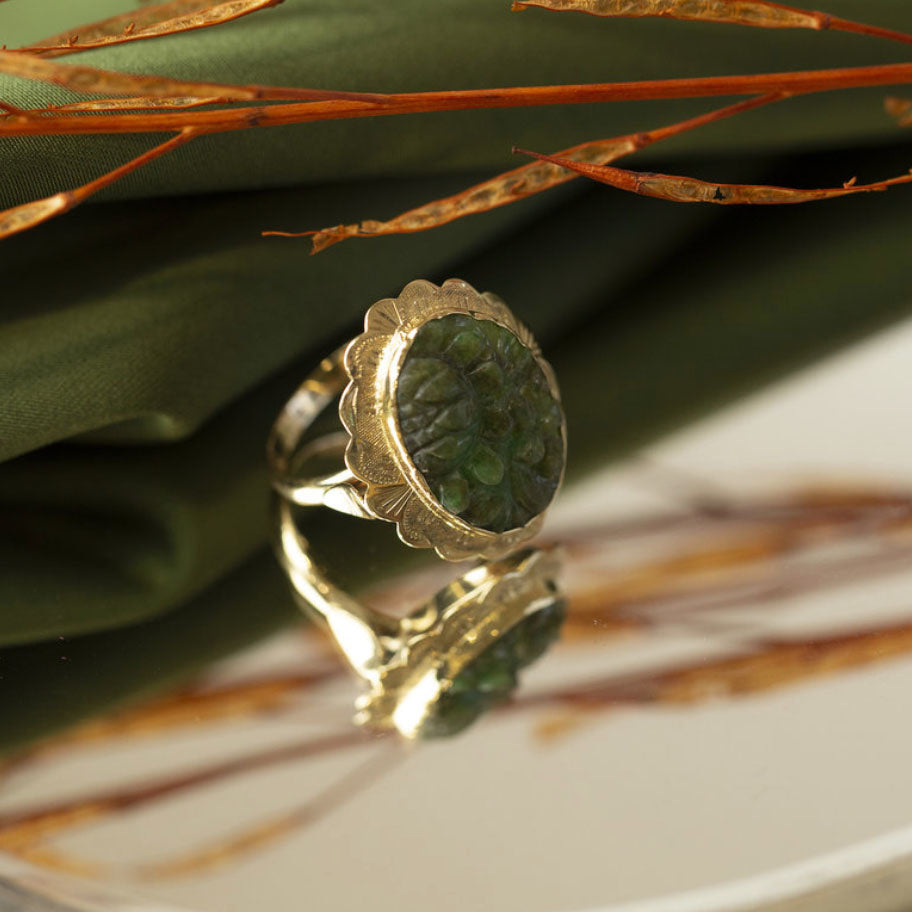
Jade: An Imperial Mineral
Jade: An Imperial Mineral
While colored gemstones such as sapphires and rubies were widely used in Europe, jade has been the most beloved gemstone in South America and Asia for centuries. In China, jade has been a symbol of status and purity for millennia. The mineral jade actually consists of two mineral groups: jadeite and nephrite.
Mayans and Aztecs
In South America, jade also has a history stretching back centuries. The Mayans and Aztecs not only used jadeite to carve religious and utilitarian objects but also powdered it for medicinal purposes.
The name 'jade' comes from the Spanish 'pietra de ijada', meaning 'stone of the pain in the side'. Early Spanish explorers observed that the inhabitants of South America tied pieces of the mineral around their waists to cure or relieve various pains and ailments.
Royal Gemstone
However, jade is best known for its ancient relationship with Chinese culture. Nephrite jade was used as early as 3000 BC. In China, they called the material 'yu', which means 'royal gemstone'. World-famous are the burial suits, made of countless small nephrite jade plaques, found in tombs from the second century BC. From approximately 3000 BC.
The first jadeite reached China from Myanmar, and early nineteenth-century sculptors created masterpieces that are still unsurpassed in concept, design, and technical execution. The rarest variant was exclusively intended for the Chinese emperors. The mineral was considered so special that Chinese emperors even waged wars to acquire extraordinary pieces. To this day, jade symbolizes prosperity, success, and happiness, and is therefore widely worn as a talisman.
Strong Stuff
Many people are unaware that jade actually consists of two materials, namely nephrite and jadeite. Both are minerals composed of very small mineral crystals, indistinguishable to the naked eye. Because jade is essentially a combination of very small mineral crystals, the material is very strong and can be well used to carve utilitarian objects: a well-known example of this is jade bracelets, which are made from a single piece of gemstone.
Jadeite is available in a wide range of attractive colors: many shades of green, yellow, and reddish-orange, plus white, gray, black, brown, and lavender (often a light purple or light gray-violet color). The color is often streaked or mottled, giving jadeite gemstones an interesting visual texture that sculptors can use to create imaginative and intriguing effects.
Shine bright like a jade stone
The quality of jade is determined differently than most other gemstones. Many gemstones are transparent and are faceted to allow light to pass through. Jade is semi-transparent to opaque and is therefore usually cut into small sculptures. Jade is therefore mainly judged by the color and luster of the material.
High-quality jadeite is semi-transparent and has an oily luster. Lower quality jadeite is opaque and has a less greasy luster. The most famous color of jade is green, but the mineral comes in a wide range of colors, from white to yellow and lilac to fiery red, blue, and brown. In Asia, white is the most valuable color, but green and purple jade are also very popular. Nephrite is also accepted as jade in the international gemstone and Jewellery industry. It ranges from translucent to opaque and can be light to dark green, yellow, brown, black, gray, or white. The colors are more muted than those of jadeite, and the material is often mottled or streaked.
(Modern gemologists use the word 'jade' as a collective term for both nephrite and jadeite. These gemstones have been connected throughout history. In fact, the term jade has also been applied to a number of gemstones and decorative materials that resemble jade, and even to some man-made equivalents that resemble jadeite and nephrite.)